
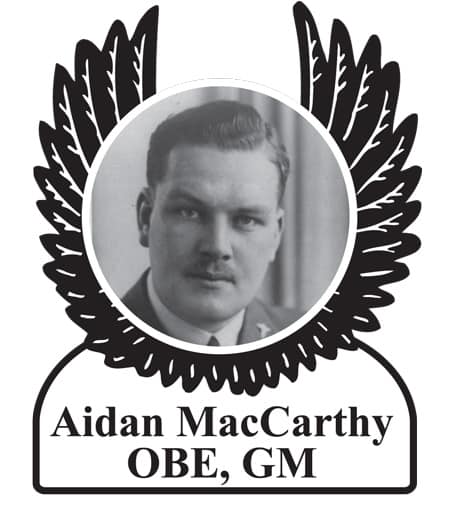
Aidan MacCarthy
Full Name: Joseph Aidan MacCarthy
Born: 19 March 1913, Castletownbere, County Cork, Ireland
Died: 11 October 1995 (aged 82), Northwood, London
Service/branch: Royal Air Force
Years of service: 1939–1971
Rank: Air Commodore
Service number: 23425
Battles/wars: Second World War
Awards: Officer of the Order of the British Empire and George Medal
Other work: Doctor
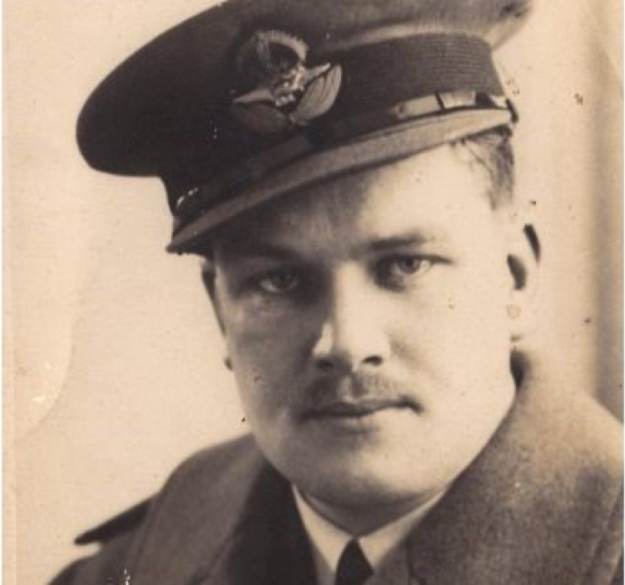
Air Commodore Joseph Aidan MacCarthy OBE, GM (1913 – 1995) was an Irish doctor of the Royal Air Force who showed great courage, resourcefulness and humanity as a prisoner of the Japanese during the Second World War, and who survived the atomic bombing of Nagasaki.
Early life
MacCarthy was born in Castletownbere on the Beara Peninsula, County Cork, where his family owned land and businesses in the town, including MacCarthy’s Bar, which still stands on the square. He was educated at Clongowes Wood College, which gave him a lifelong love of rugby, and studied medicine at University College Cork, winning a coveted Munster trophy with the UCC rugby team before graduating in 1938.
Lacking family connections, he was unable to find work as a doctor in Ireland, so he emigrated, first to Wales and then to London. There he met two former classmates from medical school and, after a night of drinking with them in Soho, decided to join the British armed forces as a medical officer. Which service, the Royal Navy or the Royal Air Force, was decided for him by a coin toss made by a nightclub hostess in the early hours of the morning.
Dunkirk and the George Medal
In 1940 MacCarthy was posted to France and evacuated from Dunkirk, attending wounded Allied soldiers while under fire from German aircraft. He spent three days sheltering from the attacks before rescue, and a kilometre out to sea his vessel was torpedoed, with numerous casualties. The badly damaged ship made it back to England with MacCarthy tending the wounded in a makeshift operating theatre. In September 1940 he was promoted to Flight Lieutenant.
In May 1941, at RAF Honington, a Wellington bomber crash-landed after its undercarriage failed and came to rest on the airfield’s bomb dump, where it caught fire. Together with Group Captain (later Air Vice-Marshal) John Astley Gray, MacCarthy entered the burning wreck and rescued two crewmen, though they were unable to save the pilot. Gray was badly burned in the rescue; MacCarthy was also burned, less seriously. Both were awarded the George Medal.
Captured in the Far East
Posted to the Far East in 1941, MacCarthy arrived shortly before Singapore fell. He was captured by the Japanese in Sumatra and imprisoned in a camp on Java, where beatings and psychological torture were routinely dished out, summary executions were frequent, and prisoners subsisted on severe rations. His medical training was put to use in improvised fashion: he devised diets to help combat dysentery and malaria, and smuggled yeast cultures hidden in rice balls to make a protein drink for the sick.
With Japan’s war effort demanding slave labour for its factories, prisoners were shipped from Java to the mainland, and in April 1944 MacCarthy found himself aboard a ship with around 980 other prisoners. For the second time in his life he was torpedoed, this time by an American submarine, and he was one of only a few dozen survivors. After 24 hours clinging to debris he was picked up by a Japanese destroyer, but when the crew discovered they had rescued prisoners of war rather than Japanese seamen, they began beating them and throwing them overboard. MacCarthy jumped and took his chances in the sea, was picked up by a whaling craft, and was brought to Nagasaki, where he was interned in a prisoner-of-war camp and put to work.
There he suffered horrendous beatings that would later require extensive surgery. To the Japanese ear “MacCarthy” and “MacArthur” were indistinguishable, and his captors assumed he must be a close blood relative of the American commander: whenever he answered his name he was struck on the forehead, which may have contributed to a brain clot in later life. He kept himself sane, he said later, by thinking about the little details of Castletownbere and the people who lived there. He had left for the war a healthy 14 stone; he came back at half that weight.
Nagasaki
MacCarthy was in charge of a working party in Nagasaki when the atomic bomb was dropped on the city on 9 August 1945. The prisoners had been warned by secret radio to take cover at a particular time of day, without further details, and he was in an air-raid shelter when the bomb fell. Emerging, the survivors found that not only the camp but the entire city had been levelled and scorched; when black rain began to fall, they thought it was the end of the world. Once more his skills as a doctor were put to use as he tried to help those who had survived, before the prisoners were moved to another labour camp away from the city.
Their stay was mercifully short. When the war ended and some ex-prisoners were intent on lynching their captors, MacCarthy locked the Japanese guards in a cell for their own safety and threw the key into the sea. After the camp was liberated, the commander handed the Irishman his ceremonial sword, in Japanese military custom one of the ultimate expressions of gratitude. As the senior Allied serviceman in Japan at the surrender, MacCarthy initially received Japan’s surrender before General MacArthur and his party arrived in Tokyo Bay several days after the end of the war.
Later years
MacCarthy was appointed an Officer of the Order of the British Empire in 1946 and promoted to the substantive rank of Squadron Leader in 1948, having held the acting rank since 1940. He remained in the RAF until 1971, rising to Air Commodore, and later practised medicine in southern England. In 1979 he published an account of his wartime ordeal, A Doctor’s War. He died in Northwood, London on 11 October 1995, aged 82.
A Doctor’s Sword
The sword came home to Castletownbere with him, and for decades he barely spoke of the war; only in the years before his death did his daughters, Niki and Adrienne, begin to learn what he had been through. “I don’t think it would be possible to survive without having such mental toughness,” Niki says. The sword can be found at MacCarthy’s Bar, the celebrated family pub whose facade features on the cover of Pete McCarthy’s travel book MacCarthy’s Bar, where Adrienne and Niki carry on the family business.
His story became the subject of Bob Jackson’s biography A Doctor’s Sword and of Gary Lennon’s acclaimed 2015 documentary of the same name, which follows Niki to Japan to retrace her father’s experiences. In a touching moment in the film she meets the grandson of the camp commander who gave her father the sword, at the graveyard where he is buried. “Going to Japan helped me realise that while my father suffered greatly, so did the Japanese people too,” she says.
In July 2017 Prince Harry opened a medical centre named in Dr MacCarthy’s memory at RAF Honington, where he remains a hero for the 1941 rescue, unveiling a plaque watched by around 20 members of the family. A special exhibition case at the base displayed the famous sword alongside his medals and the bowl he used to make protein-rich “maggoty soup” for fellow prisoners who fell ill. “It was a really proud day for us,” Adrienne said, “and we feel deeply honoured that this medical centre is now named after our father.”
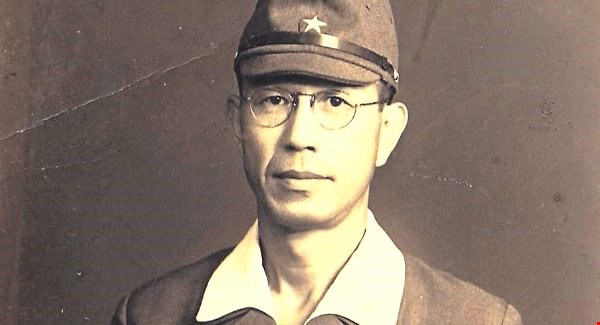
A Japanese officer
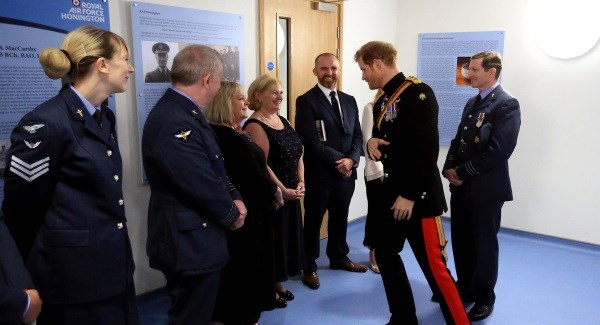
Britain’s Prince Harry meets Adrienne and Nicola MacCarthy, daughters of the late Dr Aidan MacCarthy from Co Cork.- Sean O’Riordan – Irish Examiner, Friday, July 21, 2017
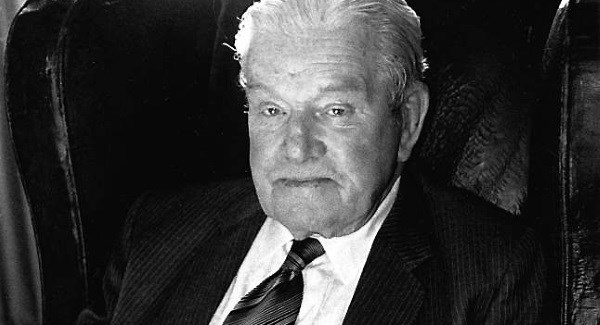
Dr. Aidan MacCarthy
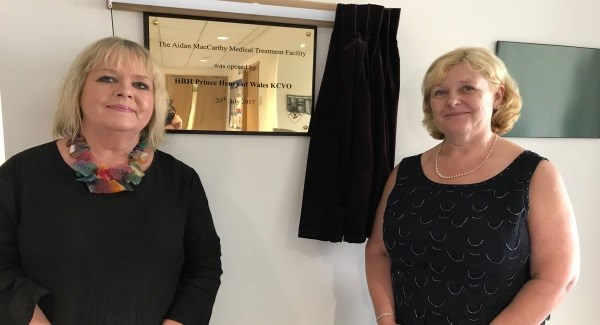
Adrienne and Nicola MacCarhy with the plaque commemorating their father.