
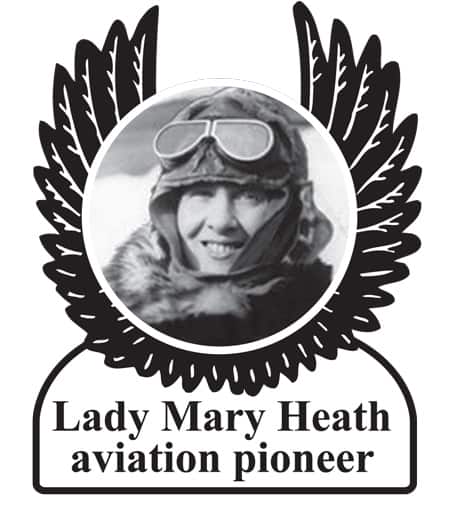
Lady Mary Heath
Full name: Sophie Catherine Theresa Mary Peirce-Evans
Born: 10 November 1896 in Knockaderry, County Limerick
Died: 9 May 1939 (aged 42) in St Leonard’s Hospital, Shoreditch, London
Cause of death: Head injury
Resting place: Surrey
Nationality: Irish
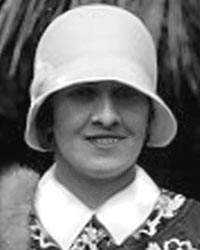
Lady Mary Heath (10 November 1896 – 9 May 1939) was an Irish aviator, born Sophie Catherine Theresa Mary Peirce-Evans in Knockaderry, County Limerick, near the town of Newcastle West. For a five-year period from the mid-1920s she was one of the best known women in the world.
Early life
When Sophie was one year old her father, John Peirce-Evans, bludgeoned her mother, Kate Theresa Dooling, to death with a heavy stick. He was found guilty of murder and declared insane, and his daughter was brought up at her grandfather’s home in Newcastle West by two maiden aunts, who discouraged her passion for sports.
After school at Rochelle School, Cork; Princess Gardens, Belfast; and St Margaret’s Hall on Mespil Road in Dublin, where she played hockey and tennis, Sophie enrolled in the Royal College of Science in Ireland (later subsumed into UCD, and now home to the Taoiseach’s office on Merrion Street). One of the few women in the college, she took a top-class degree in science, specialising in agriculture, played on the college hockey team and contributed to a student magazine, copies of which are held in the National Library of Ireland.
Athletics
Before becoming a pilot she had already made her mark. During the First World War she spent two years as a dispatch rider in England and later France, where her portrait was painted by Sir John Lavery. By then she had married the first of her three husbands and, as Sophie Mary Eliott-Lynn, was one of the founders of the Women’s Amateur Athletic Association after her move to London in 1922. She was Britain’s first women’s javelin champion and set a disputed world record for the high jump. She was a delegate to the International Olympic Committee in 1925, the same year she took her first flying lessons, and in 1926 she represented the United Kingdom in the javelin at the Women’s International Games in Gothenburg, coming fourth with a throw of 44.63 metres.
Aviation career
The International Commission for Air Navigation had barred women from commercial flying licences in 1924. Lady Heath fought the ban: the commission agreed that if she attended flight school and passed the tests she would be licensed, she did so, and the ban was rescinded, making her the first woman to hold a commercial flying licence in Britain. Along the way she set altitude records in a small plane and later a Shorts seaplane, and was the first woman to parachute from an aeroplane, landing in the middle of a football match. After her great flight from the Cape she took a mechanic’s qualification in the USA, the first woman to do so.
In an era when the world had gone aviation-mad over the exploits of Charles Lindbergh and Amelia Earhart, Lady Heath more than held her own. “Britain’s Lady Lindy”, as she was known in the United States, made front-page news as the first pilot, male or female, to fly a small open-cockpit aircraft from Cape Town to London (Croydon Aerodrome). She had thought it would take three weeks; it took three months, from January to May 1928. When the British Air Ministry refused her request for an escort aircraft across the Mediterranean, she asked Benito Mussolini instead; he agreed, on condition that she share her experiences with him. A scale model of her plane is on display at the Little Museum of Dublin, and she wrote about the experience in Woman and Flying, co-written with Stella Wolfe Murray. In July 1928 she became the first woman appointed as co-pilot with a civil airline, KLM.
Just when her fame was at its height, her life a constant whirl of lectures, races and long-distance flights, Lady Heath (she had married Sir James Heath in October 1927) was badly injured in a crash shortly before the National Air Races in Cleveland, Ohio in 1929. Before the accident she had applied for American citizenship, intending to promote aviation among American women. She was never the same afterwards. Following a divorce from Heath in Reno, Nevada in 1930, she returned to Ireland with her third husband, G.A.R. Williams, a horseman and pilot of Caribbean origin, and became involved in private aviation, briefly running her own company at Kildonan, near Dublin, in the mid-1930s and helping produce the generation of pilots that would establish the national airline, Aer Lingus.
Back home in Ireland she was reputed to have landed her plane on every flat field in the country, and always made at least one annual visit to Ballybunion to see her Aunt Cis. To the joy of the locals she would land in a place called Larkin’s Field and, for a small fee, take the more intrepid spectators into the air for short spins. On one visit the local breeder Jim Clarke presented her with a greyhound.
Marriages
Her first marriage was to Major William Eliott-Lynn, after which she was widely known as Mrs Eliott-Lynn. He died in London in early 1927, and on 11 October 1927 she married Sir James Heath at Christ Church in Mayfair, London. In January 1930 she filed for divorce from Heath in Reno, Nevada, on the grounds of alleged cruelty, and was awarded a decree nisi in May of the same year. On 12 November 1931 she married the airman G.A.R. Williams in Lexington, Kentucky.
Death
On 9 May 1939, aged 42, she died in St Leonard’s Hospital, Shoreditch, London, following a fall inside a double-decker tram. At the inquest the conductor gave evidence that she had seemed “very vague” on the top deck, and another passenger had remarked “I think the lady is asleep”, before she fell down the stairs and hit her head on the driver’s controller box. A pathologist found no evidence of alcohol but detailed an old blood clot that may have caused the fall, and the jury returned a verdict of accidental death. In failing health in her final years, she was destitute when she died. On 15 May 1939 her ashes were scattered over Surrey from an aircraft flown by her husband from Croydon Airport.
“It may be merely the impatience of a woman, but is it not time we ceased to quibble over the exact amount in pounds, shillings, and pence each unit is to contribute to the cost of an All-red route and looked at the broader Imperial aspect? Trade, they used to say, followed the Flag. To-day and in the future it will also follow the aerodrome, for without speedy communications commercial competition is impossible.”
– Lady Sophie (Mary) Heath
The Queen flew in on a Moth
Before Amelia Earhart, there was Lady Mary Heath, “Queen of the Skies”.
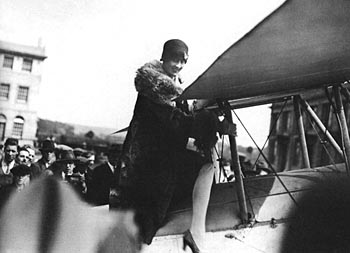
The Lady-Queen flew into Jacksonville at 3 p.m. on 4 January 1929. Her tiny De Havilland Moth appeared as a dot in the far-off sky. Onlookers gaped from the field. Perfectly and mundanely the Moth met the grass; the Queen alighted every inch the British Olympian who had flown the length of darkest Africa.
“She made the wings fast in flying position, climbing around the plane like a great cat,” the Jacksonville Journal said. “She was clad in a colorful cretonne smock and wore high, soft leather boots… She spun the propeller and started the engine herself while a score of men and boys stood open-mouthed in a semi-circle.”
Lady Mary Heath was tall and imposing, fresh and ruddy and brisk. She was a champion athlete, sharing the world record for the women’s high jump, and a flyer such as the locals had never seen. Flying is so safe, the Lady-Queen said, “a woman can fly across Africa wearing a Parisian frock and keeping her nose powdered all the way.” (She made the trip with a Bible, a shotgun, a couple of tennis rackets, six tea gowns and a fur coat, at a time when men flew with boiled eggs and ham sandwiches.)
Lady Heath chatted with Jacksonville aviation enthusiasts Ralph Greene and Robert Gamble at the airport. She and her companion, the wife of a Royal Flying Corps officer, were guests of the George Washington Hotel that night. Next day, in a lonely sky, the Lady-Queen and her Moth again became dots in the distance and were gone.
Lady Heath and Amelia Earhart
Amelia Earhart first became interested in Avro Avian aeroplanes in 1928, after her goodwill flight across the Atlantic to England. While still overseas, and in great demand by the media, Earhart slipped away and met Lady Heath for a flight in her Avian. She fell in love with the aircraft, accepted an offer to buy it and shipped it back to the United States, flying the small open-cockpit biplane across America later that year. A flying Avian painted in the same silver and blue, and carrying the same registrations (US 7083, British G-EBUG), survives today as the only airworthy Avian in North America.
Further Reading
Lindie Naughton, Lady Icarus: The Life of Irish Aviator Lady Mary Heath (Ashfield Press, Dublin, 2004)
Judy Lomax, Women of the Air (1986)
Stephanie Daniels and Anita Tedder, A Proper Spectacle: Women Olympians 1900–1936
Sophie Eliott-Lynn, Athletics for Women and Girls: How to be an Athlete and Why (1925)
“Heath, Lady Sophie Mary” in Rosanne Welch, Encyclopedia of Women in Aviation and Space (1998)
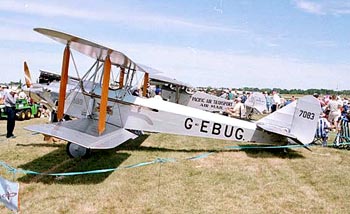
Avro 594 Avian III G-EBUG
Construction number (c/n) R.3/AV/412 29.10.27
Reg. G-EBUG, Cert.of Reg. No.1510 to Lady Heath, Manchester
85hp A.D.C. Cirrus II engine.
Image: Oshkosh, 27 August 2001, © V.N. Smith 2001