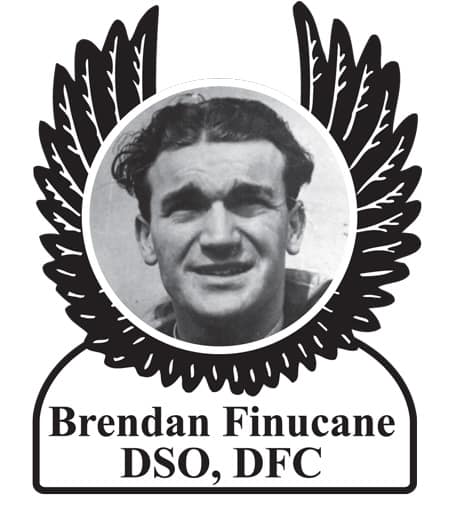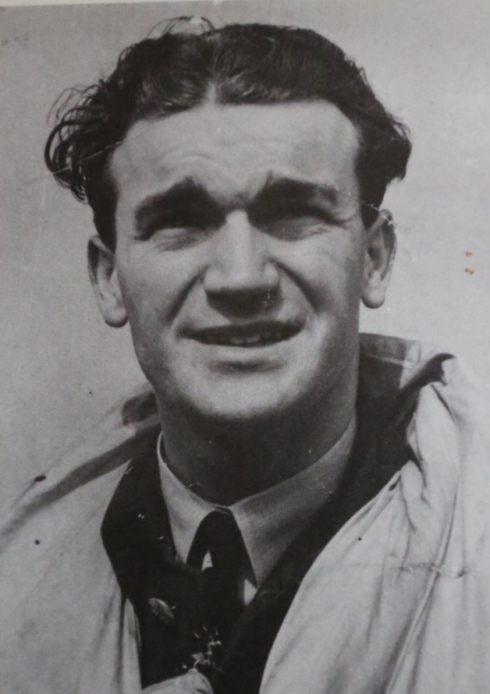
Brendan Finucane
Nickname(s): Paddy
Born: 16 October 1920, Rathmines, County Dublin, Ireland
Died: 15 July 1942 (aged 21), English Channel
Service/branch: Royal Air Force
Years of service: 1938–42
Rank: Wing Commander
Service number: 41276
Unit: No. 65 Squadron RAF, No. 452 Squadron RAAF, No. 602 Squadron RAF
Commands held: No. 602 Squadron RAF, Hornchurch Wing
Battles/wars: Second World War – Battle of Britain, Channel Front
Awards: Distinguished Service Order, Distinguished Flying Cross & Two Bars
Wing Commander Brendan Eamonn Fergus Finucane, DSO, DFC & Two Bars (16 October 1920 – 15 July 1942), known to his colleagues as Paddy Finucane, was a Second World War Royal Air Force fighter pilot and one of the most celebrated flying aces of the war. He was officially credited with 28 aerial victories, five probably destroyed, six shared destroyed, one shared probable and eight damaged; post-war research suggests his true total may have been as high as 32. In June 1942, aged 21, he became the youngest wing commander in the history of the RAF. A month later he was dead.
Early life
Brendan Finucane was born on 16 October 1920 at Rathmines Road, Dublin, the first child of Thomas and Florence Finucane. His mother was English, from Leicester; his father, a bank cashier, had fought as a member of the Irish Volunteers under Éamon de Valera’s command in the 1916 Rising, and had been taught mathematics at college by de Valera himself. Brendan grew up during the Troubles and the Civil War: as an infant he and his mother were nearly killed when caught in crossfire between the Black and Tans and the IRA. Four more children followed: Raymond, Clare, Monica and Kevin.
In the summer of 1932 the Finucane brothers were taken to an air show at Baldonnel and had a ten-minute flight, and Brendan came away wanting to be a pilot. At the Christian Brothers O’Connell School in North Richmond Street he was a successful rugby player, rower and champion boxer; among his classmates was the future broadcasting legend Michael O’Hehir. In November 1936 the family moved permanently to London, where his father set up an office on Regent Street, and Brendan finished his schooling at Cardinal Vaughan Memorial School before starting work as an accountant, a job he loathed. In November 1937 he approached his father about joining the RAF. Despite his Republican past, the senior Finucane agreed, believing a military career would give his son the direction his own youth had lacked, and his parents cashed in their insurance policies to support him even though Thomas was by then unemployed.
A shaky start
Finucane applied at 17, the minimum age, and in August 1938 reported to 6 Elementary and Reserve Flying Training School at Sywell to fly the de Havilland Tiger Moth. He was slow to come to grips with the aircraft: within his first fortnight he nearly flew into a boundary hedge, and a burst tyre on landing approach ended with the undercarriage destroyed. “Further heavy contact,” Finucane said, “[and] there would have been no more Brendan or Mr. Morris!” His instructor, Roland Morris, was critical of his habit of trying to force the aircraft to do what he wanted instead of coaxing it.
Advanced training at RAF Montrose in Scotland went little better. He struggled with the more powerful Hawker Hart, and one instructor remarked that “the ground was never quite where Paddy expected it to be!”. After failing a flying test his future was reviewed, and he survived only by showing improvement and a steely determination. He passed out in June 1939 graded average, with 59 per cent, and shortly afterwards crashed a radio-controlled Queen Bee target aircraft in bad weather, escaping with a cut thumb. Nothing in Paddy Finucane’s training suggested what was to come.
Battle of Britain
After war broke out Finucane spent the winter of 1939–40 ferrying engineers around airfields in an antiquated Vickers Virginia. But the fall of France left Fighter Command desperate for pilots, and in June 1940 he was sent to Hawarden to convert onto the Supermarine Spitfire. On 13 July 1940 he joined No. 65 Squadron at RAF Hornchurch, just as the Battle of Britain was getting under way.
His first scramble, on 25 July, ended in a wheels-up landing when his worn Spitfire sprang a glycol leak. His first victory came on 12 August: attacking a formation of Messerschmitt Bf 109s off North Foreland, he fired from 250 yards down to 50 and sent one into the Channel. Later that day, as the squadron refuelled at Manston, the airfield came under low-level attack; Finucane took off downwind as the first bombs fell and claimed a probable and one damaged. On Adlertag, 13 August, the heaviest day of fighting so far, he claimed another Bf 109 destroyed and one probable. By the battle’s end he had two destroyed, two probables and one damaged, and a squadron report noted: “I have great hopes of this officer. He is keen and intelligent and shows likelihood of becoming a very efficient leader.”
That winter, billeted near Chichester, he watched from a pub as German pathfinders marked Southampton for bombing, and drove into the burning city. Seeing the destruction, he remarked: “Until this war is won we must shoot every Jerry from the sky.”
The Circus offensive
In early 1941 Fighter Command went on the offensive, sending small bomber formations escorted by large numbers of fighters over France to draw the Luftwaffe into battle: the Circus operations. Finucane opened his year on 4 January by shooting down a Bf 110 off Selsey Bill after a 15-minute fight, and in February claimed a Bf 109 over France on the third Circus of the war.
On 14 April 1941 he was posted as a flight commander to the newly formed No. 452 Squadron, the first Royal Australian Air Force squadron in Fighter Command, and promoted to acting flight lieutenant. Flying his final sortie with 65 Squadron the next day, he claimed the Bf 109 that made him an official ace, though German records suggest his opponent that day was the great ace Adolf Galland, whose landing gear dropped during the fight (possibly leading Finucane to claim him destroyed) and who flew home undamaged, complete with a crate of lobster he was delivering for a general’s birthday. Finucane was awarded the Distinguished Flying Cross on 25 April.
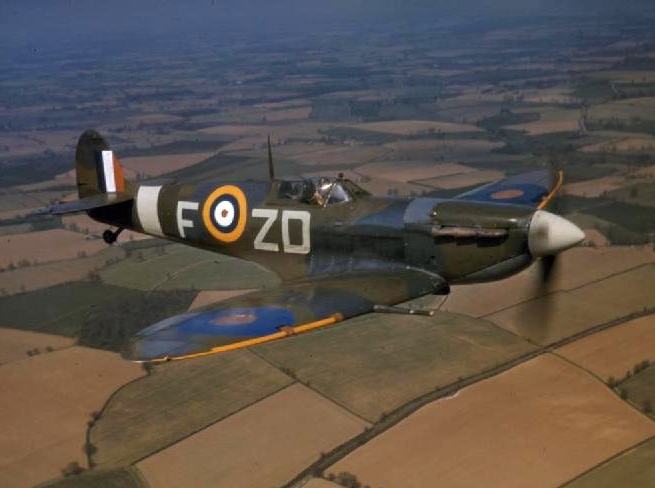
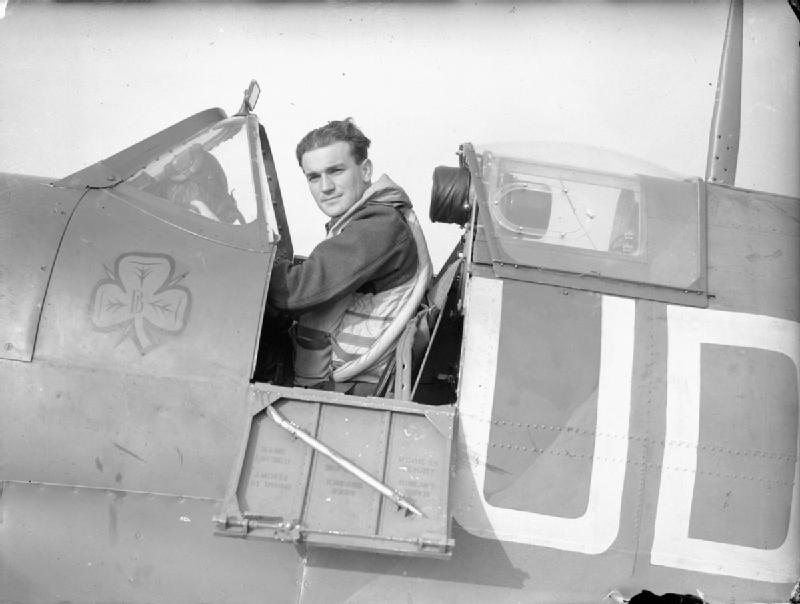
His start with the Australians was inauspicious: flying too close in formation on 3 May, his propeller sliced through the tailplane of his commanding officer, Squadron Leader Roy Dutton, who crash-landed and cracked several ribs. But Finucane became a popular commander who encouraged a relaxed atmosphere to get the best from his pilots, and his Spitfire soon carried a green shamrock painted on the cockpit fairing, his personal insignia on four successive aircraft. At Kenley, where 452 joined the Scots of 602 and the New Zealanders of 485 in the new Kenley Wing, he formed a close friendship with the Australian pilot Keith Truscott, and met Jean Woolford, who became his fiancee.
Through the summer and autumn of 1941 Finucane’s score climbed at an extraordinary rate: two on 3 August, three on 9 August including two shared with Keith Chisholm, three on 16 August in three separate operations (in one fight, after his gunsight failed, he opened fire from ten yards and blew the tail off a Bf 109), two more on 19 August, two on 27 August, and three on 20 September, when he flew through the debris of an exploding Bf 109 and shot another off Chisholm’s tail. A Bar to his DFC came on 22 August, with the citation “Flight Lieutenant Finucane has been largely responsible for the fighting spirit of the unit,” and a second Bar in September. “I owe a great deal to Paddy Finucane,” Truscott said. “He coached me in air fighting and taught me everything I needed to know.”
Fame
The Air Ministry released the squadron’s exploits to the press, and Finucane became a national hero overnight. On the eve of his 21st birthday the Daily Herald prepared the headline “Finucane wants 3 for his 21st”; the Daily Mail ran “Spitfire Finucane shoots down 20 Nazis”. On 11 October 1941 he was awarded the Distinguished Service Order for 21 enemy aircraft shot down, and when his ground crew painted 21 swastikas around the shamrock on his Spitfire, he ordered them removed.
Two days later, celebrating with a night of drinking, he vaulted the stone balustrade of Croydon Town Hall, unaware of an 18-foot drop on the other side, broke his heel bone and spent weeks in hospital. From his hospital bed he broadcast an account of his service on the BBC, and on 25 November 1941, with his parents and brother present, King George VI personally decorated him with the DSO and DFC and two Bars at Buckingham Palace. During this period his wingman Chisholm, shot down over the Channel in October, began one of the war’s great escape sagas, evading recapture through Poland, Germany and France until Paris was liberated in 1944.
Squadron Leader
On 20 January 1942 Finucane was given command of No. 602 (City of Glasgow) Squadron at RAF Redhill, promoted to squadron leader by the station commander, the Irish Group Captain Victor Beamish. It was Beamish who, on a Channel patrol on 12 February, discovered the German battleships Scharnhorst and Gneisenau making their famous Channel Dash from Brest; within minutes of his report Finucane was leading 602 against the German fleet, and he later gave evidence to the official enquiry into the failure to stop the break-out.
On 20 February 1942, on a two-Spitfire sortie to Dunkirk, Finucane met the new Focke-Wulf Fw 190, superior to his Spitfire V in almost every department, and was hit by six machine-gun rounds that drove a piece of fuselage into his leg. His 29-year-old Australian wingman Dick Lewis fought off six further attacks and shot one Fw 190 down while Finucane, bleeding heavily, flew home. “The cockpit was awash with blood,” Finucane wrote. “It was not until I was feeling a touch sick and dizzy it dawned on me that it was my blood. It made me mad. Good Dublin blood should not be wasted. Just then things began to go black – however I managed to land back at dispersal without a crack-up will never be known.” He passed out as he shut down the engine.
Back on operations from March, he claimed an Fw 190 that month over Hazebrouck and several more victories in the spring, bringing his official total to 28.
The youngest Wing Commander
By late June 1942 Finucane had completed 108 fighter operations over France, and on 27 June he was promoted to lead the Hornchurch Wing, at 21 the youngest wing commander in the history of the RAF. In his short tenure he tightened flying discipline, loosened formation flying and increased low-level navigation training.
On 15 July 1942 he led the wing on a Ramrod ground-attack operation against a German Army camp at Étaples, timed to hit at lunchtime. Crossing the beach at Le Touquet, the Spitfires strafed machine-gun positions, and at 12:22 Finucane’s radiator was hit by ground fire. His wingman, Alan Aikman, alerted him to the white plume of smoke; Finucane acknowledged with a thumbs up. Regulations required the wing to carry on, and radio silence was kept so the German interception services would not learn that someone important was in trouble.
Finucane flew slowly out to sea, talking calmly to Aikman as he glided along in his stricken fighter. Some eight miles off Le Touquet he broke silence with his last message. Aikman saw him pull back the canopy and, before taking off his helmet, say “This is it Butch”. The ditching was well executed, but the waves were difficult to predict: the Spitfire’s nose struck the water and disappeared in a wall of spray, and went straight down. He had once warned Truscott: “Don’t ditch her… If you are over water and in trouble, bail out. Get out of her fast. She doesn’t take to water like a duck; she takes to it like a fish and goes straight down.” The exact circumstances of his death remain unknown. He was 21 years old.
Remembrance
Over 2,500 people attended his memorial service at Westminster Cathedral. A rose was planted in the memorial garden at Baldonnel Aerodrome in Dublin, home of the Irish Air Corps, where Brendan and his brother Ray first flew. His name is inscribed on the Air Forces Memorial at Runnymede, which commemorates airmen with no known grave, and on the Battle of Britain Memorial on London’s Embankment as one of The Few. His flying logbook can be seen in the Soldiers and Chiefs exhibition at the National Museum of Ireland, Collins Barracks, and his uniform was donated by the family to the Royal Air Force Museum in London. His brother Raymond served in No. 101 Squadron RAF and survived the war.
A note on victory claims: RAF claims against the German fighter wings on the Channel Front are notoriously difficult to verify, as almost all German records were destroyed. After the war, two of Finucane’s “probables” were found to have in fact been destroyed, which is why some sources credit him with as many as 32 victories.
For more detailed information: http://acesofww2.com/UK/aces/finucane