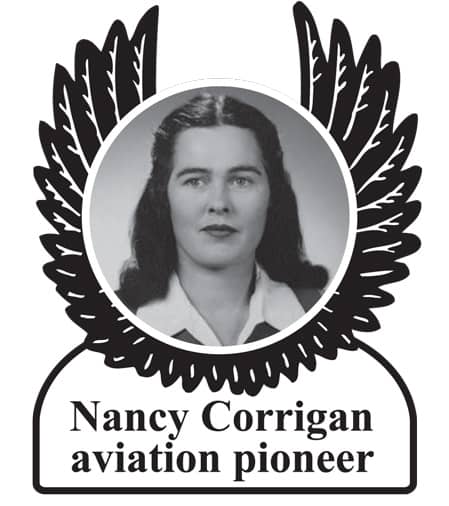
Nancy Corrigan
Born: 21 June 1912, Owenduff, Achill, Ireland
Died: 1983 (aged 70-71) Sarasota, Florida, United States
Cause of death: Heart attack
Nationality: Irish
Aviation career
Known for: Second female commercial pilot in the US
First flight: 1932
Flight license: Cleveland, Ohio
Racing career
Best position: 1948 Kendall Trophy, Cleveland, third place
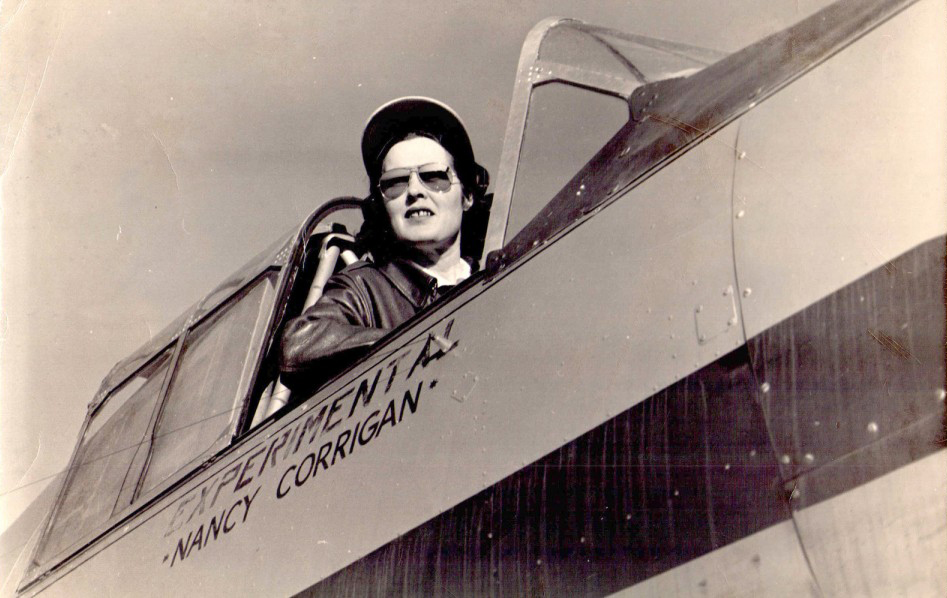
Aircraft: AT-6 military trainer
Annie R. “Nancy” Corrigan (1912 – 1983) was an early aviator in the US, who trained as a pilot in Cleveland, Ohio while working as a nursemaid and fashion model. There were two sorts of runways in her life, one belonging to aviation and the other to fashion: she became one of the most successful aviation pioneers in the US, and funded her flying career by modelling in New York.
Early life
Corrigan was born in Owenduff on Achill in the west of Ireland, the youngest of four daughters of John Corrigan, a railway worker on the Westport to Achill line (now the Greenway). He was killed in a railway accident, leaving his wife Maggie (née Ward) near destitute, and each of the daughters emigrated to the United States in turn. Nancy followed in 1929, aged 17, sailing from Cork to New Jersey and travelling on to Cleveland, Ohio, where she found work as a nanny with a wealthy family in Shaker Heights.
Learning to fly
In 1932, the same year Amelia Earhart became the first woman to fly solo across the Atlantic, Nancy began taking flying lessons in her off-duty hours, completely unbeknownst to her family or her employers. Where her drive and persistence came from, no one knows: family speculation points to the landing of Alcock and Brown in Connemara, to Earhart’s success, or to Cleveland’s National Air Races. After just four hours and 45 minutes of instruction, almost unthinkably rapid, “the brunette colleen” made her first solo flight and the front page of Cleveland’s Plain Dealer. “I wasn’t a bit afraid. It felt like a million dollars,” she told reporters.
The speed was born of necessity. Flying was glamorous but expensive: a pilot’s licence cost around $700, a huge sum for a nursemaid earning about $10 a week. After three years she left her job and obtained employment with the John Robert Powers agency in New York, one of the largest modelling agencies in the US, whose models were known as “Powers Girls”. She worked for Powers for about ten years, principally as a hand model, earning enough to continue her flying and acquire the necessary piloting certificates.
War years and after
When the US joined World War II her skills were sought after, and she became an instructor of fighter pilots and air cadets at Spartan College in Tulsa, Oklahoma, joining the Women Flyers of America at a time when aviation was considered a men’s club and women had a hard time getting recognition. “They faced discrimination, sabotage when racing and there was a distaste generally for them,” one commentator recalled.
After the war she became only the second woman to earn a commercial pilot’s licence in the US, and in the 1950s one of only two women holding a multi-engine commercial rating. “She was a natural instructor and patient, and one of only two women at the time who managed to break into the commercial corporate field,” recalled a man she instructed, still flying at the age of 85. During six years running the flight programme at Stephens College in Columbia, Missouri, she supervised 600 women, who graduated without a single failed test. She went on to log 600,000 miles in a commercial flying career that ended with her retirement to Florida in the 1960s.
Air racing
For the Kendall Trophy at the 1948 National Air Races in Cleveland, with 5,000 flying hours behind her from 16 years in the air, Nancy ploughed her savings into an AT-6 military trainer for the event. So many successful Corrigans in Cleveland (lawyers, doctors and officials) clubbed together to help with the purchase that she painted “Corrigans” on the fuselage of the plane. “It was a test of skill, aircraft management and bravery, and very dangerous,” her former student recalled. She finished third.
Legacy
Corrigan died of a heart attack in Sarasota, Florida in 1983. Her life was celebrated in the TV documentary Nancy Corrigan: Spéirbhean Acla (“Sky-Woman of Achill”), first broadcast on the Irish language channel TG4 on 6 January 2015, and she is the subject of a special exhibition, “The Model Pilot”, at the International Women’s Air and Space Museum at Burke Lakefront Airport, Cleveland.